

Linking Logic in the RedTeam Subnet
The linking logic is designed to identify when multiple UIDs are likely controlled by the same underlying miner and to treat them as a single effective identity during emission distribution.
Core Objective
Ensure fair treatment by grouping associated UIDs into one logical miner entity for incentive calculations.
When Linking Is Applied
Linking is not a one-time process. It is a dynamic evaluation that occurs frequently to reflect the real-time state of the network.
- Execution Frequency: Every weight setting interval (approximately every 20 minutes).
- Statelessness: Each interval is evaluated independently.
- Linking is recomputed from scratch each time.
- No assumptions or data are carried over from previous intervals.
Current State Only
The system always reflects the current signals of each UID, ensuring it adapts immediately to changes in miner infrastructure.
How Linking Works
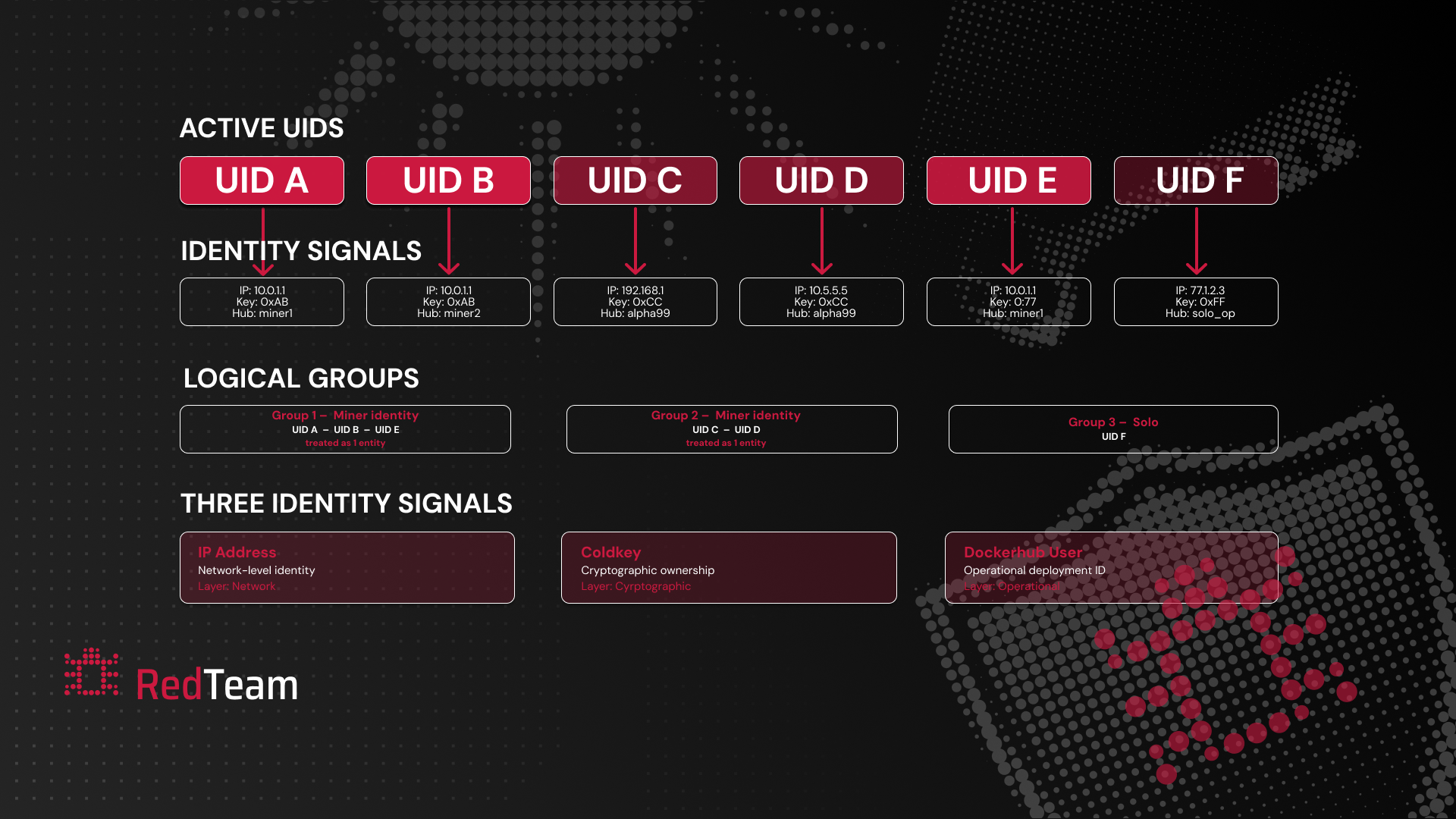
During each interval, the system evaluates all active UIDs based on three primary identity signals:
- IP Address: Network-level identification.
- Coldkey: Cryptographic ownership proof.
- DockerHub Username: Operational identification from image deployments.
Grouping Mechanism
UIDs that share these signals (either fully or in specific combinations) are grouped together.
- Each group represents a single logical miner.
- Each UID belongs to exactly one group for that interval.
Key Design Characteristics
1. Multi-Signal Identity Matching
Linking does not rely on a single identifier. By combining Network, Cryptographic, and Operational identities, the system significantly reduces the chance of trivial duplication or spoofing.
2. Single-Step Evaluation
All signals are processed together in one step rather than sequentially.
- Prevents partial bypass: For example, changing only an IP while keeping the same coldkey will still result in linkage.
- Consistency: Ensures robust and predictable grouping decisions.
3. Time-Scoped Grouping
Since linking is recomputed every interval, it is highly flexible. A UID's group can change if its identifiers change, with no permanent or cached linkage history affecting the current window.
4. Independence from Scoring
Linking operates purely on identity signals and is decoupled from performance metrics.
- It does not depend on scores.
- It does not consider submission timestamps.
Practical Effect
Within a given interval, multiple UIDs controlled by the same operator are collapsed into one identity. This prevents a single miner from appearing as multiple independent participants, ensuring a level playing field.
Non-Punitive Design
The system does not block or remove UIDs. It simply groups them for fair treatment during reward distribution.
Benefits
- Reduces UID-based abuse: Limits the advantage of running multiple UIDs from the same setup.
- Keeps evaluation current: Reflects real-time conditions by recomputing every 20 minutes.
- Avoids rigid penalties: No permanent banning, only temporary, interval-based association.
- Adds operational friction: Requires consistent separation across IP, keys, and accounts to avoid linkage.
Summary
- Interval: Applied every 20 minutes.
- Signals: Groups UIDs based on IP, Coldkey, and DockerHub username.
- State: Stateless across intervals; reflects only the current state.
- Purpose: Ensures multiple UIDs from the same source are treated as one logical miner per interval.